



Reaction Hooks: The Format Behind the Best-Performing App Ads
The reaction hook - a real human reaction cut into a product demo - dominates app advertising. Why it works, how to build one, where to source clips.
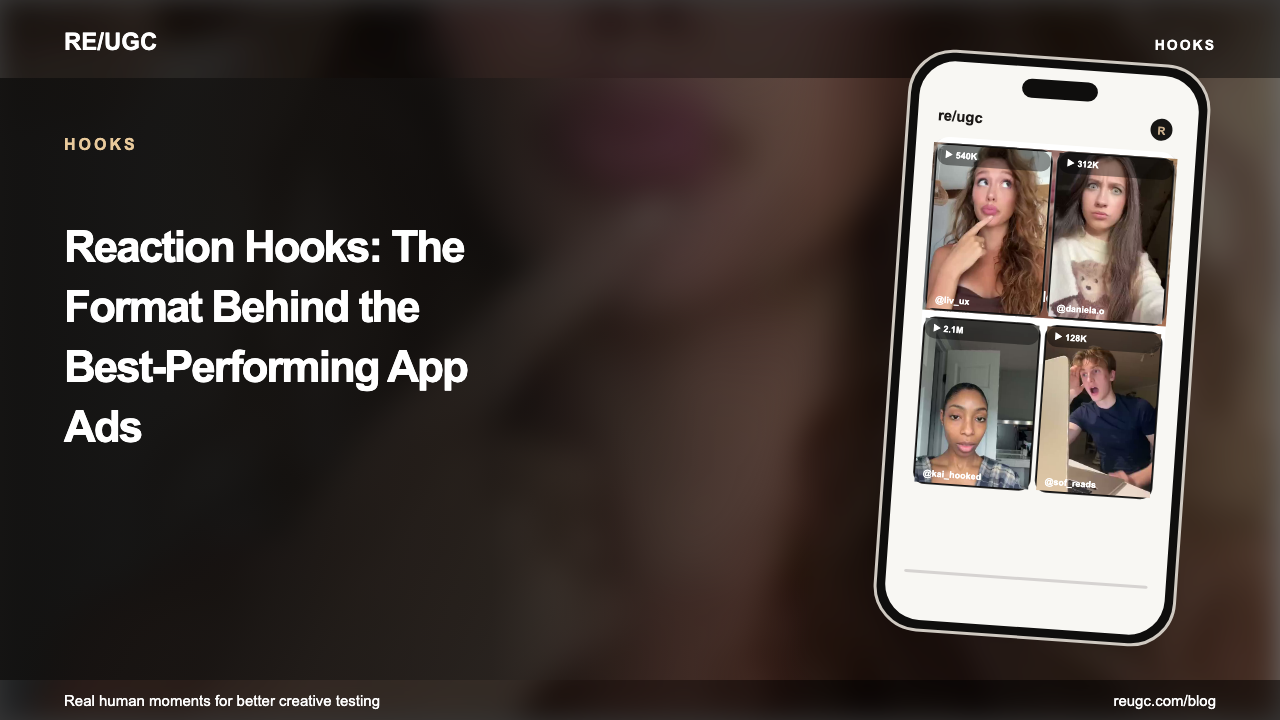
A reaction hook is a 3–5 second clip of a real person reacting — shocked, skeptical, delighted, overwhelmed — placed at the front of a video, followed by a hard cut to a product demo. The reaction earns the watch time. The demo earns the click.
It sounds too simple to be a strategy. It's become the dominant format in app and software advertising anyway, because it solves a problem that no amount of production budget can solve: your product is a screen, and screens don't stop scrolls.
The problem reaction hooks solve
Physical products have inherent visual interest — texture, reveal, hands, transformation. Software has a rectangle full of interface. And interface reads as *advertising* to a scrolling viewer, which triggers the skip reflex before a single feature is seen.
You can't out-design this. A more beautiful UI is still a UI. What you can do is change what occupies the first frame — put a human being there instead, and let the product arrive after attention has already been secured.
Nobody stops scrolling for a dashboard. Everybody stops for a face.
Why faces work: the mechanism
Face processing is pre-conscious and involuntary. Dedicated neural machinery handles it faster than deliberate attention operates, which means you read an expression before you decide whether to. That half-second of involuntary processing is precisely the window you're competing for in a feed.
A reaction adds a second mechanism on top: an unexplained emotion is an open loop. Seeing someone react strongly to something you can't see creates a small, specific, closable curiosity — *what are they looking at?* — and the answer is obviously seconds away. Narrow, closable gaps are exactly the kind viewers stay for. More on the underlying psychology in viral hooks.
Anatomy of a reaction hook ad
- 0–3s — the reaction. A genuine human expression, already in motion at frame one. Bold caption in the top third: 'Wait, it does this automatically?'
- 3s — the hard cut. No fade, no transition, no logo sting. The cut itself is a second pattern interrupt.
- 3–8s — the wow moment. Your single most surprising capability, working. Not onboarding, not a menu tour, not a feature list. The one thing that makes people say 'hang on.'
- 8–15s — one supporting capability. Kept moving, narrated casually.
- 15–20s — soft CTA. Name on screen, 'it's free to try.' Hard closes underperform in short form.
Matching reaction to product
| Your product's core moment | Reaction to use | Caption angle |
|---|---|---|
| It does something people assume is impossible | Jaw-drop, wide eyes | "This shouldn't be possible" |
| It's far cheaper than the alternative | Disbelief, double-take | "How is this free?" |
| It removes a dreaded chore | Relief, exhale, slump back | "I'm never doing that manually again" |
| It's in a crowded, distrusted category | Skeptical squint → convinced | "I wanted this to fail" |
| It's genuinely delightful to use | Laugh, grin, lean in | "Okay this is actually fun" |
| It saves an absurd amount of time | Shock then laughter | "Six hours → four minutes" |
Why this format is uniquely testable
The strategic advantage of reaction hooks isn't only performance — it's modularity. Because the hook and the demo are separate clips joined by a hard cut, you can swap the first three seconds without touching anything else. One demo plus twenty reactions is twenty ads, assembled in an afternoon.
This turns creative testing from a production problem into a selection problem, which is the whole reason teams using this format ship five variations a day while teams filming custom ads ship five a month. The system for exploiting that is in creative testing.
Sourcing reaction footage
- Licensed clip libraries. Pre-recorded reaction clips with commercial rights included, available instantly. Best fit for this format specifically, because the clip doesn't need to feature your product — the demo does that job.
- Commissioned creators. $100–$300 per video and one to two weeks. Worth it when you need a specific demographic or the reaction must be tied to visible product usage.
- Film it yourself. Free, and genuinely viable — your own genuine first-time reaction to a feature is often better than anything you could brief. Requires you to be comfortable on camera.
- Customer reactions. The gold standard for credibility when you can get them, though supply is unpredictable and rights must be secured explicitly for paid use.
What all four have in common: the reaction must be real. AI-generated faces underperform badly in exactly this position, because the involuntary face-processing that makes the format work is also what detects that something is off. Detail in AI UGC: do AI actors beat real reactions?
Mistakes that break the format
- Holding the reaction too long. Past five seconds the viewer wants the payoff. Cut early rather than late.
- Fading between reaction and demo. The hard cut is doing work; a fade throws it away.
- Mismatched emotion. A jaw-drop over a modest convenience feature reads as manipulation and burns trust.
- Overacted reactions. Performed shock is instantly legible. Genuine mild surprise beats theatrical amazement.
- Reusing one reaction forever. The format's whole advantage is cheap variation. One reaction on repeat wastes it and fatigues fast.
- Burying the caption. Bottom-third text is covered by platform UI, so the claim never lands and the face is doing the job alone.
Frequently asked questions
What is a reaction hook?
A short clip — typically 3–5 seconds — of a real person reacting emotionally, placed at the start of a video before a hard cut to a product demo. The human face stops the scroll, and curiosity about what caused the reaction carries the viewer into the demo.
Why do reaction hooks work so well for apps?
Because software demos are screen recordings, and interface reads as advertising to a scrolling viewer. Leading with a human face secures attention pre-consciously, so the product arrives after the skip decision has already been avoided.
How long should the reaction clip be?
Three to five seconds. Shorter than three and the emotion doesn't register; longer than five and the viewer starts waiting for the payoff instead of anticipating it.
Can I use AI-generated reactions?
Not effectively in this position. The involuntary face-processing that makes reaction hooks work is the same machinery that flags synthetic faces as subtly wrong, and hesitation in the first two seconds is fatal. Use real footage for hooks.
Where do I get reaction clips for ads?
Licensed clip libraries are the best fit for this format since the clip doesn't need to show your product — the demo does. You can also commission creators, film your own genuine reactions, or license customer footage with explicit paid-usage rights.