


Ad Hooks: 20 Openers Proven in Paid Social
Paid traffic is colder than organic and needs different hooks. Twenty ad openers that work on cold audiences, why they work, and how to test them.
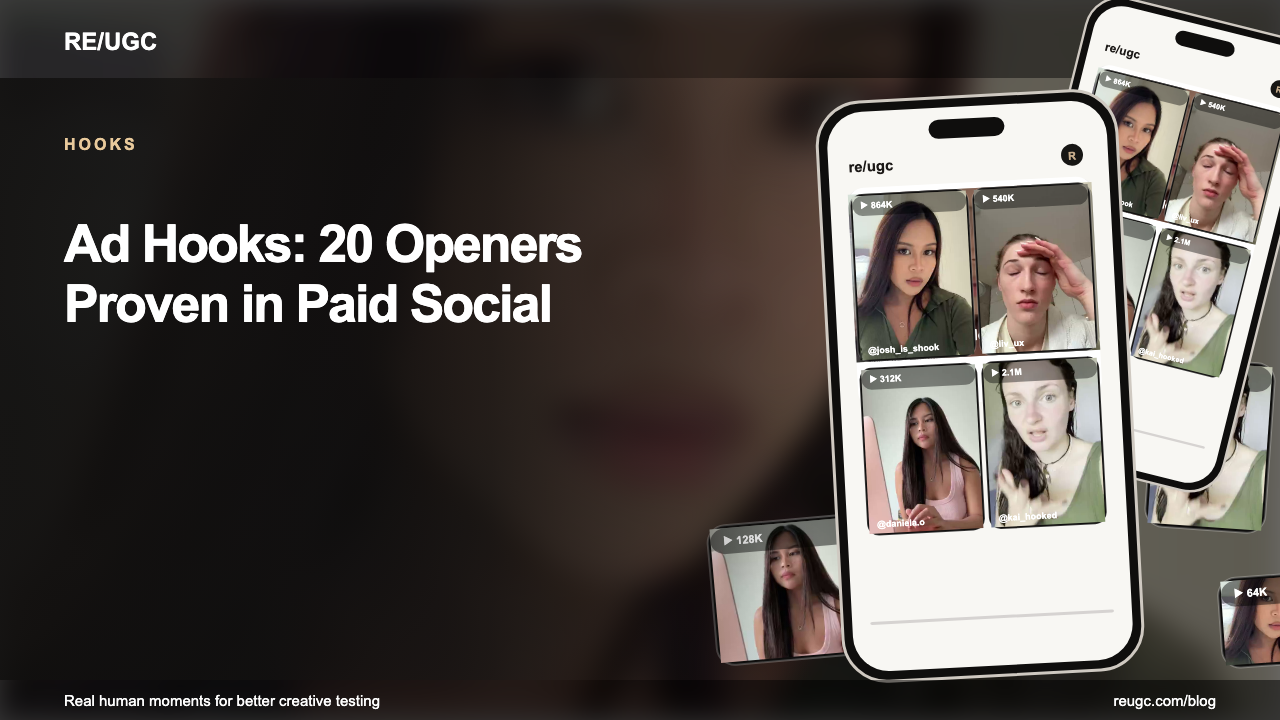
An ad hook is the opening one to three seconds of paid creative. It does the same job as an organic hook — stop the scroll — but against a harder audience: someone who never chose to see you, has no relationship with your brand, and has been trained by thousands of previous ads to skip on reflex.
That difference matters more than most advertisers account for. Hooks that win organically often flop in paid, because organic viewers arrive with mild goodwill and paid viewers arrive with none. The openers below are selected for cold traffic specifically. For the full mechanics of how hooks work, see the video hooks guide; for a broader swipe file across all contexts, see 150+ hook ideas.
What changes when traffic is paid
| Organic viewer | Paid viewer | |
|---|---|---|
| Relationship | Followed you or was served by interest match | None — pure interruption |
| Default posture | Mild curiosity | Active skepticism |
| Skip speed | Fast | Faster |
| Best-performing hook types | POV, story, community | Disbelief, price, warning, objection-naming |
| Tolerance for slow build | A second or two | Effectively zero |
| What kills it | Feeling like an ad | Feeling like a *bad* ad |
The practical consequence: paid hooks should front-load the tension, not the charm. Cold viewers don't stay for personality; they stay for a claim they can't immediately dismiss or an objection stated so precisely they feel seen.
The 20 ad hooks
Objection-naming openers (highest converting on cold traffic)
- "I thought this was another subscription trap."
- "I almost returned this."
- "I really wanted this to fail."
- "I don't usually post about apps, but."
- "Before you buy — watch this part."
Why they work: the viewer's objection is voiced before they can act on it. Once someone else says the doubt out loud, the viewer's job shifts from *dismissing* to *evaluating* — and evaluating requires watching. Pull these lines verbatim from your cancellation surveys and support tickets; the exact phrasing your real skeptics use outperforms anything you'd write.
Price and value openers
- "I was paying $250 a clip for this."
- "How is this free?"
- "This replaced a $500/month tool."
- "I did the math and I'm upset."
- "One payment. I checked twice."
Why they work: price is the objection every cold viewer holds. Leading with it is pre-emptive, and the anchor-then-reveal structure creates a gap the demo can fill.
Loss and warning openers
- "Stop doing this immediately."
- "This is why your ads aren't converting."
- "You're losing money every day you don't know this."
- "Nobody warned me, so I'm warning you."
- "Don't buy anything until you see this."
Why they work: loss aversion is a stronger motivator than gain seeking, and the gap widens on cold traffic where there's no existing goodwill to trade on. The rule: the payoff must genuinely deliver on the warning. Bait that doesn't cash produces an immediate exit, and the platform reads that exit as a quality verdict on your entire ad.
Disbelief openers
- "Wait, it does this automatically?"
- "This shouldn't be possible."
- "I've been doing this wrong for years."
- "Someone built this and didn't tell anyone?"
- "I gasped. Out loud."
Why they work: paired with a genuine reaction face, these get the pre-conscious pattern interrupt *and* the specific claim in the same two seconds. The most reliable structure in paid app advertising — and the reason reaction clips became the default opener for software ads.
Writing your own: the four-part test
- Is it under 8 words? If not, cut. Long hooks aren't read, they're scrolled past.
- Does it open exactly one loop? Two claims make zero. One tension, cleanly stated.
- Can the next 5 seconds visibly start paying it off? If your demo can't begin cashing the promise by second 5, the hook is writing checks the ad can't clear.
- Would a real person say this out loud? Read it aloud. If it sounds like copy, rewrite it until it sounds like a text message.
Testing ad hooks without wasting budget
- Fix everything but the hook. Same demo, same length, same CTA, same audience. One variable or the test tells you nothing.
- **Ship five different hook *types*,** not five wordings of one idea — an objection-namer, a price shock, a warning, a disbelief open, a result-first.
- Budget for exit velocity, not for winners. Enough spend per variant to get a clear hold-rate read in 48–72 hours; you're buying information, not results.
- Judge on hold rate first. Hold rate isolates the hook. CTR judges the demo, CPA judges the offer — diagnosing out of order sends you optimizing the wrong layer for weeks.
- Iterate on the winner's mechanism. If the price hook won, you've learned your audience flinches at cost — test three more price angles before moving on.
The five ways ad hooks fail
- Opening on a logo. The most expensive frame in paid media, spent identifying yourself as skippable.
- Warming up. 'Hey guys, so today…' is dead air you paid for at CPM rates.
- Being clever instead of clear. Wit needs context; cold traffic has none. Clarity converts, cleverness confuses.
- Promising what the demo can't show. Every unpaid hook promise trains the algorithm that your ad disappoints.
- Testing one hook. One creative isn't a test, it's a guess with a budget attached.
Frequently asked questions
What is an ad hook?
The opening 1–3 seconds of a paid ad — the first visual, on-screen text, and spoken words — engineered to stop a cold viewer from scrolling. It's the highest-leverage element in paid social creative.
How are ad hooks different from organic hooks?
Paid viewers arrive colder and more skeptical because they never chose to see you. Objection-naming, price, warning, and disbelief hooks over-index in paid, while POV, story, and community-led hooks tend to perform better organically.
How many ad hooks should I test?
At least five distinct hook types per demo, refreshed weekly. Creative volume is the strongest predictor of paid social account performance, and the hook is the cheapest element to vary.
How do I know if my hook is working?
Look at 3-second hold rate or thumbstop ratio, not CTR or CPA. Hold rate isolates the hook's performance; CTR reflects the demo and CPA reflects the offer. Kill anything below your account average hold rate at 72 hours.
Where do I find good ad hook ideas?
Your own customer language — support tickets, cancellation surveys, review pages, and comment sections. Real objections in customers' own words consistently outperform hooks written by marketers.