


UGC Platforms Compared: Marketplaces, Agencies, AI Tools & Clip Libraries
Every way to source UGC compared: creator marketplaces, agencies, AI generators and clip libraries - real costs, turnaround, rights, and best fit.
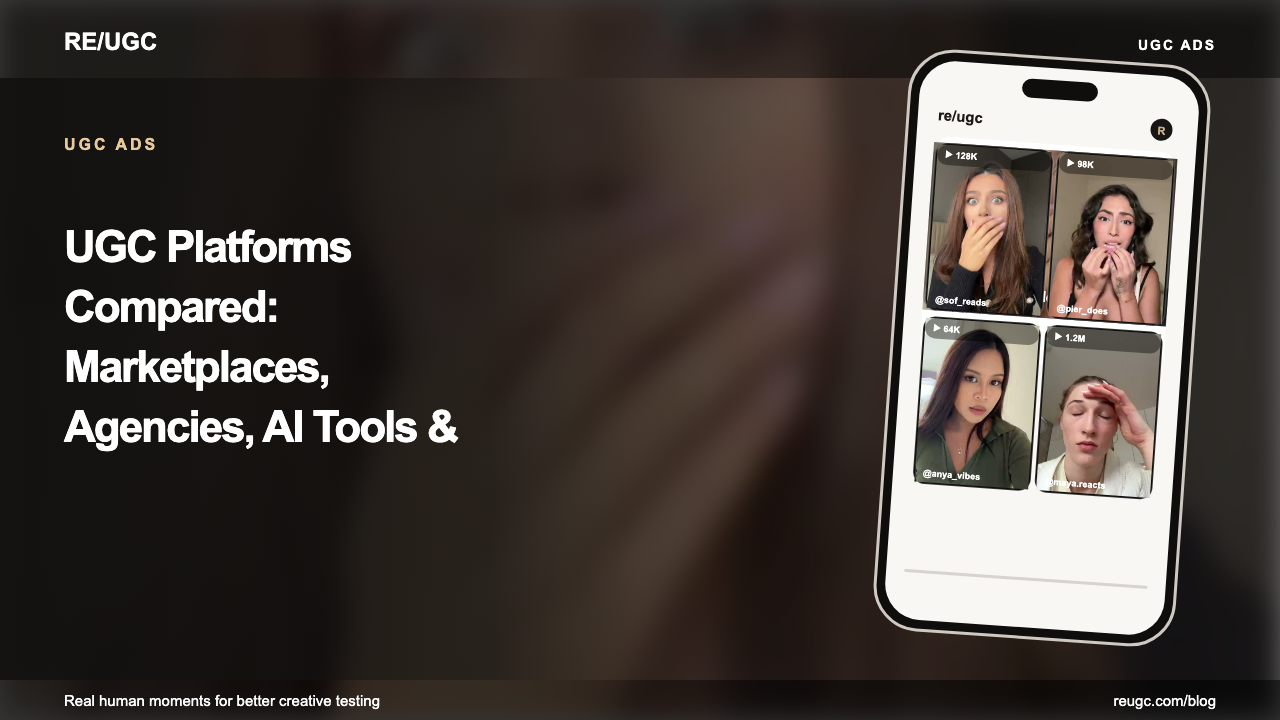
'UGC platform' covers five genuinely different business models that get lumped together because they all end with video files in your ad account. They differ enormously in cost, speed, rights, and — most importantly — what part of the ad they're good for. Picking the wrong category is the most common and most expensive UGC mistake teams make.
This is the buyer's guide: what each category actually is, honest pricing, the rights traps, and a decision framework based on your stage and spend. If you're earlier than this, start with the UGC ads playbook.
The five categories at a glance
| Category | What you get | Typical cost | Speed | Best for |
|---|---|---|---|---|
| Creator marketplaces | Briefed custom videos from vetted creators | $60–$250/video + fees | 3–10 days | Custom testimonials at moderate volume |
| Full-service agencies | Managed strategy, casting, production, iteration | $1,500–$10k+/month | 1–3 weeks/batch | Funded teams wanting it handled |
| Creator-sourcing SaaS | Software to find, brief, and manage your own creators | $100–$500/month + creator fees | Varies | In-house teams scaling a creator roster |
| AI UGC generators | Synthetic avatars, voiceover, scripts | $30–$150/month | Minutes | Script/voice testing, localization |
| Licensed clip libraries | Pre-recorded footage, rights included | One-time or flat fee | Instant | Hook testing at volume; front-of-ad reactions |
1. Creator marketplaces
You post a brief, creators apply or get matched, you approve, they film at home and deliver in days. The category most people mean by 'UGC platform.'
Strengths: custom scripts, your product physically in frame, real people describing real usage. Unbeatable for testimonials and demos that require the product in hand.
Weaknesses: quality variance is the persistent complaint — the same brief produces one usable video and two unusable ones, and you pay for all three. Turnaround makes weekly iteration impossible. And the per-clip model punishes exactly the behavior that wins in paid social: testing many variations of the same idea. At $150 a clip, five hook variants cost $750 before you learn anything.
Rights trap: many marketplaces bundle organic usage but charge extra for paid ads, whitelisting, or usage beyond 6–12 months. Read the license tiers before assuming you can run it as an ad.
2. Full-service UGC agencies
A managed service: strategy, creator casting, scripting, production, editing, sometimes media buying. Monthly retainer, defined deliverable count.
Strengths: genuinely hands-off. Good agencies bring creative direction you don't have in-house and a creator bench they've already quality-filtered. If your constraint is attention rather than money, this solves it.
Weaknesses: cost per experiment is brutal. A $4,000/month retainer producing twelve videos is $333 per creative — and creative testing wants dozens of cheap shots, not a dozen expensive ones. Iteration speed is capped by the agency's production cycle, which is measured in weeks while ad platforms learn in days.
Ask before signing: who owns the footage after cancellation, whether raw files are included or only edits, how many revision rounds per asset, and whether unused concepts remain yours.
3. Creator-sourcing SaaS
Software rather than service: tools to discover creators, send briefs, manage contracts and rights, track deliverables, and handle payment. You still pay creators separately.
Strengths: the right answer once you're running a real creator program — ten-plus creators, recurring briefs, rights and payments that need an audit trail. Cheaper per video at scale than marketplaces and far cheaper than agencies.
Weaknesses: it's infrastructure, not output. If nobody on your team owns creator relationships, the software just becomes an empty dashboard you pay for monthly.
4. AI UGC generators
Synthetic avatars, voice cloning, and script generation. Near-zero marginal cost, instant output.
Strengths: unmatched for script variation testing, voiceover, and localization into new languages.
Weaknesses: synthetic faces underperform badly at the hook, where the viewer's brain is deciding whether it's watching a person or an ad — and detection literacy is now high enough that being clocked as AI can invert an ad's social proof. There's also real regulatory exposure in presenting an AI actor as a satisfied customer. Full analysis in AI UGC: do AI actors beat real reactions?
5. Licensed clip libraries
Pre-recorded reaction footage — reactions, expressions, lifestyle moments — licensed with commercial rights, available instantly. The newest category and the least understood, because people assume 'stock' and picture the corporate-handshake era.
Strengths: the cost-per-experiment problem disappears. The hook — the highest-leverage, most-worth-testing part of any ad — becomes effectively free per variation, so five hook variants against a fixed demo costs nothing extra and takes an afternoon. Real human faces, so no uncanny tax. Rights cleared up front, so no license archaeology before a campaign.
Weaknesses: the clips are pre-shot, so they can't feature your product in hand. That's a real constraint — and mostly irrelevant for the reaction-hook format, where the opening 3–5 seconds is a human reacting and the product appears in the demo that follows. For testimonials that must show your product, you still want a creator.
Best fit: anyone testing hooks weekly. This is the model RE/UGC runs — reaction clips sorted by emotion and niche, full commercial rights, one-time price rather than per-clip fees.
The cost math nobody runs
Comparing platforms on cost per video is the wrong metric. The right one is cost per experiment — what it costs to learn one thing about what your audience responds to.
| Route | Cost to test 5 hooks on one demo | Time to result |
|---|---|---|
| Marketplace creators ($150/clip) | $750 | 1–2 weeks |
| Agency retainer (5 of 12 monthly assets) | ~$1,650 of a $4k retainer | 2–4 weeks |
| AI generator | ~$0 | 1 hour (but weak hook performance) |
| Clip library (flat fee, already owned) | $0 marginal | 1 afternoon |
This is why high-spend accounts end up blended rather than loyal to one category: libraries for hook volume, creators for product-in-hand testimonials, AI for voiceover and translation. Each category does the job it's actually good at.
How to choose: a decision framework
- Pre-revenue / bootstrapped, need ads now: clip library for hooks + your own screen recording. Zero recurring cost, ship this week.
- Early traction, testing weekly: library for hook volume, plus one or two trusted creators for testimonials. This is where most product-led startups live.
- Scaling paid spend ($20k+/month): blended — library, a managed creator roster via sourcing SaaS, AI for localization. Cost per experiment is your governing metric.
- Funded but attention-constrained: agency for the pipeline, library alongside it so your team can still test hooks between agency cycles.
- Expanding internationally: whatever you already use, plus AI voiceover for localization of proven winners.
Frequently asked questions
What is a UGC platform?
Any service that supplies user-generated-style content to brands. The term covers five distinct models: creator marketplaces, full-service agencies, creator-sourcing software, AI generators, and licensed clip libraries — each suited to different parts of an ad and different budgets.
Which UGC platform is cheapest?
AI generators have the lowest sticker price, and licensed clip libraries have the lowest cost per experiment since variations are free once you own the library. Creator marketplaces and agencies cost the most per test because you pay per clip or per retainer.
Do UGC platforms include rights for paid ads?
Not always. Many marketplaces include organic usage but charge extra for paid advertising, whitelisting, or usage beyond 6–12 months. Always confirm paid-ad usage, duration, and platform coverage in writing before running content as an ad.
Should I use an agency or do UGC in-house?
Agencies make sense when attention is your constraint and budget isn't. If you're testing creative weekly, in-house with a clip library and one or two creators iterates far faster and costs less per experiment.
What's the difference between a UGC marketplace and a clip library?
A marketplace commissions new custom videos from creators — slower, per-clip pricing, your product in frame. A clip library licenses pre-recorded footage instantly with rights included — ideal for the reaction hooks at the front of an ad, where the product appears in the demo that follows rather than in the clip itself.