






Curiosity Hooks That Earn the Next Three Seconds
Use open loops without resorting to vague clickbait. A practical guide to curiosity hooks that pay off in the product demo.
A curiosity hook opens a gap between what the viewer sees and what they suddenly need to know. The gap is the engine, but the engine is only useful when the answer actually arrives. 'You will not believe this' is a vague threat, not a loop; 'I changed one setting and cut this workflow from eight taps to two' hands the viewer a specific question and a concrete reason to watch. That difference — a fair, specific, quickly-paid-off open loop — is what separates curiosity hooks from clickbait.
This guide covers the mechanics behind the gap, the five loop patterns that reliably hold attention in short-form ads, the rules that keep a hook honest, and the testing loop that tells you whether your curiosity is paying for itself. It's the curiosity-specific companion to our video hooks guide; if you want lines to start from, the hook ideas swipe file has a full category of them.
Why the curiosity gap works
Curiosity is the discomfort of a missing piece of information. Psychologists describe it as an information gap: the brain registers a discrepancy between what it knows and what it could know, and the discomfort is mild but real until the gap closes. Scrolling is the enemy of that discomfort — every swipe can close the loop by replacing the tension with something else — so the hook's job is to make the tension bigger than the swipe cost.
- The gap must be specific. 'You won't believe this' names no missing fact, so there's nothing to close. 'The setting nobody showed me' names an exact thing you're about to reveal.
- The gap must be closable. The viewer needs a plausible shape of the answer — otherwise curiosity curdles into suspicion. Tease an eight-tap workflow and they can imagine a two-tap one.
- The gap must be paid off fast. The more seconds you hold the loop open, the more the viewer assumes you're stringing them along. Payoff inside the first half of the video.
Clickbait opens a loop and never closes it. A curiosity hook opens a loop and closes it inside the same video — the closure is the product demo.
The anatomy of a fair open loop
1. The premise
The first frame must establish enough context that the viewer understands the category: who this is for, what's being discussed, what the stakes are. Without a premise, the gap has nothing to hang on — a viewer who doesn't know what 'eight taps' refers to has no reason to care that it became two.
2. The gap
The hook withholds one answer, not the entire premise. The strongest gaps are built from a specific object, number, or action — 'one setting,' 'eight taps to two,' 'the free version did one thing better.' Numbers are almost unfairly effective because they create a verifiable claim the viewer wants to check.
3. The payoff
The demo closes the loop with evidence. In a UGC-style ad this is where the screen recording or product clip arrives — the reveal the hook promised. The closer the payoff matches the promise, the more trust the ad banks for the next view. If the ad spends ten seconds teasing and one demonstrating, the viewer learns that your hooks are empty: that wins a view and loses a customer.
Five reliable open loops
Nearly every curiosity hook that works in paid social is one of these five patterns. Each pairs an opening line with a specific payoff the demo must deliver:
| Loop | Opening | Payoff |
|---|---|---|
| Hidden step | The setting nobody showed me | Reveal the setting in use |
| Unexpected result | I tried this on my worst case | Show the output |
| Comparison | The cheaper option did one thing better | Name the difference |
| Process | Watch what happens after I upload this | Time-lapse the result |
| Question | Why did this work when the usual fix failed? | Explain with evidence |
You'll find concrete, tested line-by-line versions of all five patterns in the curiosity category of the hook ideas list — and see them deployed across real formats in our UGC ad examples.
Rules that keep curiosity honest
The discipline is simple: the loop must be worth closing, and it must close. These are the rules we apply to every curiosity hook before it ships:
- Show enough context that the viewer understands the category. No premise, no gap.
- Withhold one answer, not the entire premise. The viewer should guess the shape of the reveal.
- Use a specific object, number, or action in the opening. Vagueness is the clickbait tell.
- Start paying off the loop within three seconds. The tease earns the cut; the demo pays it off.
- End with a useful takeaway rather than another teaser. One loop per video, closed completely.
Where curiosity crosses into clickbait
The line between a curiosity hook and clickbait is not emotion — both exploit the same pull. It's delivery. Clickbait promises a reveal it can't deliver, or delays it past the point of patience. Curiosity hooks pay what they owe, on schedule, in the same video. Audiences punish the former instantly with skips, and platforms price those skips into your CPA. For the discipline of keeping paid creative honest, see the rules in our ad hooks guide.
- Avoid 'secret' unless the information is genuinely underused.
- Do not hide pricing, limitations, or the product until the final frame.
- Test curiosity against a direct problem hook with the same demo — the problem-solution hook guide has the comparison framework.
- Use captions so the loop survives sound-off viewing.
- Measure qualified clicks, not only completion rate.
Pairing the loop with the right visual
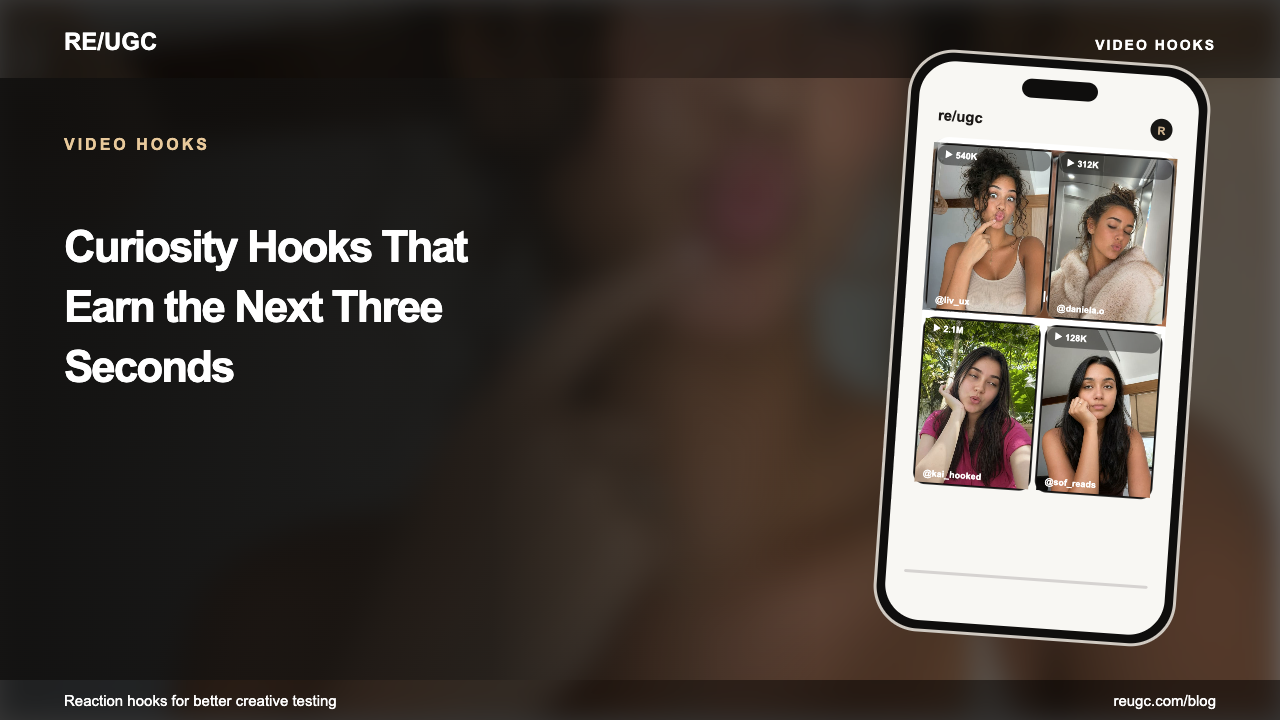
The open loop lives in the caption and the first spoken line, but the visual decides whether anyone reads it. An expressive reacting face — mid-emotion, mid-thought — is the strongest possible carrier for a gap because the face itself says 'something surprising is happening.' That's the core of why reaction hooks open so many winning app ads.
The gap-and-face formula
Frame one: a filmed or AI UGC character reacting to something off-screen. Caption: the specific claim that names the gap ('I changed one setting and cut this from eight taps to two'). Seconds 3–5: hard cut to the demo that closes the loop. The face earns the pause, the caption defines the question, the demo delivers the answer. Script templates for exactly this sequence live in the UGC script library.
Testing curiosity hooks
Curiosity is a hypothesis about your audience, not a fact about your product. What teases one niche feels empty to another, so the loop needs the same testing discipline as every other hook variable:
- Pick one demo and hold it constant. Same screen recording, same CTA, same destination.
- Ship three curiosity variants against one direct hook. The direct hook is the control — it tells you whether curiosity is adding anything at all.
- Compare hold rate and qualified click-through. A curiosity hook that holds but under-converts has a payoff problem, not a gap problem.
- Judge the loop, not the words. If 'the setting nobody showed me' wins, test three more hidden-step angles — you've learned your audience likes to be in on a secret.
- Rotate winners before fatigue. Loops that teach nothing get swiped past the moment the audience has seen them once.
Curiosity pairs naturally with the creative testing framework — and because the hook is the cheapest thing to change in an ad, you can run this loop weekly. For the fuller picture on the reaction-open format that carries most of these gaps, the UGC ads playbook walks through it end to end.
Frequently asked questions
Is curiosity clickbait?
It becomes clickbait when the promise is vague, exaggerated, or never answered. A specific open loop with a real payoff in the same video is simply good storytelling — and the market rewards it with higher hold rates.
How long should I hold the answer?
Start the payoff in the first few seconds and finish it before the CTA. The exact timing depends on complexity and audience temperature — colder audiences need the payoff sooner, before skepticism turns into a swipe.
Can B2B products use curiosity?
Yes. Unexpected workflow results, hidden costs, and useful configuration details are strong B2B loops. The trick is keeping the payoff concrete: a visible dashboard or a before/after workflow closes the loop faster than a feature list.
What's the difference between a curiosity hook and a question hook?
A question hook asks a direct question the viewer answers internally. A curiosity hook opens a broader information gap — often with a statement rather than a question — that only watching can close. Many strong hooks combine both.
Do curiosity hooks work sound-off?
Only if the on-screen caption carries the specific claim. The gap must be visible without audio, which is one more reason to keep the caption under eight words in the top third of the frame.