


Viral Hooks: What Actually Makes People Stop Scrolling
The psychology behind viral hooks: curiosity gaps, pattern interrupts, and the retention math that decides distribution. Virality is engineered.
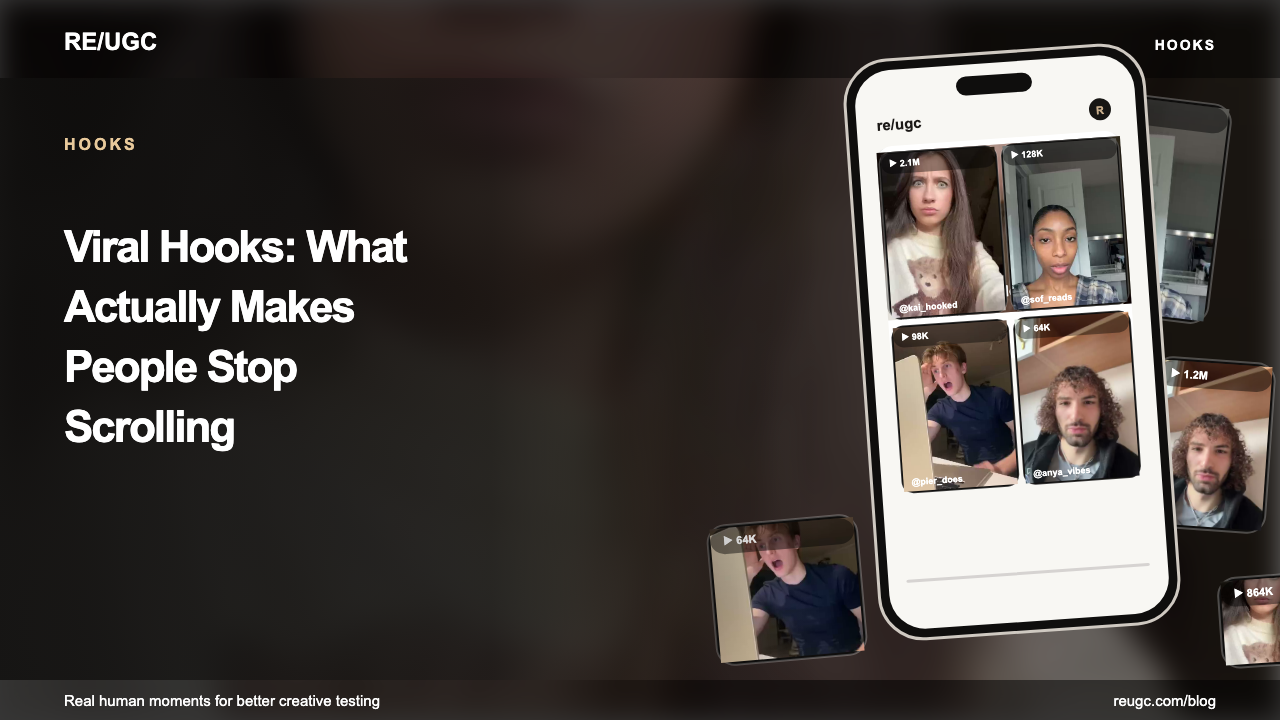
A viral hook is an opening that stops scrolling at a high enough rate to trigger algorithmic distribution. That definition is deliberately unromantic, because virality is mechanical: platforms test your video on a small audience, measure whether people stay, and expand reach if they do. Nothing mystical happens. The hook is the input; distribution is the output.
Understanding the mechanism is what separates people who occasionally go viral from people who can do it repeatedly. This piece covers the psychology, the retention math, and the practical engineering.
The retention math behind virality
Every short-form platform runs roughly the same loop: seed the video to a few hundred viewers, measure early retention and engagement, then either expand to a larger audience or stop. Each expansion round re-runs the test. A video that holds 80% of viewers at three seconds passes round after round; a video that holds 40% dies in the first one.
This compounds brutally. A modest improvement in hold rate doesn't produce a modest improvement in reach — it produces a *categorically different* outcome, because passing one more expansion round multiplies your audience rather than adding to it. That's why two videos with identical content and different opening seconds can end up three orders of magnitude apart in views.
You don't go viral by being seen by more people. You go viral by not being skipped by the people who already saw you.
The three psychological mechanisms
1. The pattern interrupt
Scrolling is a semi-automatic state. The brain predicts what's coming and disengages. A hook works by violating the prediction — a face mid-emotion, an object that doesn't parse, motion that started before you arrived. Anything requiring a moment of conscious processing breaks the trance, and that moment is the entire window you're competing for.
Faces are the strongest interrupt available, because face processing is pre-conscious and involuntary. You cannot choose not to read an expression. That involuntary half-second is why reaction openers outperform nearly everything else, and it's the mechanism explained in full in our video hooks guide.
2. The curiosity gap
Once attention is caught, it needs a reason to persist. The curiosity gap — a piece of information the viewer now wants and doesn't have — supplies it. The gap must be narrow and closable: 'what made her react like that?' works because the answer is obviously seconds away. 'What is the meaning of success?' fails because the answer is diffuse and the viewer doesn't believe you have it.
3. Self-relevance
The fastest possible qualification signal: *this is about me*. A named profession, a specific frustration, a situation described precisely enough that the viewer recognizes their own life. Specificity feels like relevance, and relevance defeats the skip reflex more reliably than novelty does.
What viral hooks have in common
| Property | Why it matters | Failure mode without it |
|---|---|---|
| Motion in frame one | A still frame invites the scroll to continue | Video is skipped before it starts |
| A face or a number | The two fastest-processed stimuli | Nothing registers in the available window |
| Under 8 words of text | ~2 seconds is 6 words of scroll-reading | Text goes unread entirely |
| One idea only | Two claims split attention and resolve to zero | Viewer disengages while deciding what it's about |
| A closable gap | The viewer must believe the answer is seconds away | Curiosity without confidence in payoff = skip |
| Honest payoff | Over-promise trains the algorithm you disappoint | Account-level distribution suppression |
Why most 'viral hook' advice fails
- It copies phrases instead of mechanisms. 'Wait for it' worked because it created a closable gap, not because of the specific words. Once the phrase spread, it became a signal for low-quality payoffs and stopped working while the underlying mechanism kept working fine.
- It treats virality as a content property. Virality is a *relationship* between a video and an audience at a moment. The same hook can be viral on TikTok and dead on LinkedIn.
- It ignores the payoff. A hook that earns attention the content can't hold produces high early retention and catastrophic completion — which the algorithm reads as a worse signal than never hooking anyone.
- It optimizes for views instead of the right views. A hook that goes viral with an audience that will never buy is an expensive way to feel successful. Broad hooks bring broad audiences; if you're selling, some qualification in the hook is worth the reach you lose.
Engineering a viral hook
- Start from the payoff. What's the single most surprising thing in your content? The hook's job is to promise exactly that, and nothing bigger.
- Choose your interrupt. Face, anomaly, motion, or number. For products, a genuine human reaction is the highest-percentage choice.
- Write the gap in under 8 words. State the tension, not the topic. 'Wait, it does this automatically?' not 'Let me show you a feature.'
- Verify it works muted. If the hook lives in the audio, most of your audience never received it.
- Cut hard into the payoff by second 3. Every second between hook and payoff leaks viewers.
- Ship five, keep one. Nobody predicts winners reliably — including people who claim to. The advantage goes to whoever tests most, not whoever guesses best.
Frequently asked questions
What is a viral hook?
An opening — usually the first 1–3 seconds — that stops scrolling at a high enough rate to trigger algorithmic expansion. Platforms test videos on small audiences and expand reach based on early retention, so the hook is the mechanical input to distribution.
Can you engineer a viral video?
You can engineer the conditions reliably — a strong pattern interrupt, a closable curiosity gap, and an honest payoff — but not guarantee any individual outcome. The practical approach is volume: test many hooks, since hold rate is measurable even when virality isn't predictable.
Why do some videos go viral with no followers?
Short-form platforms distribute by video performance rather than follower count. A new account's video gets the same initial test audience as an established one, so retention decides the outcome, not history.
What's more important, the hook or the content?
The hook determines how many people see the content, and the content determines whether the algorithm keeps expanding. A great hook on weak content produces a spike then suppression; weak hook on great content produces nothing at all. The hook is the constraint you fix first.
How do I measure whether my hook worked?
Use 3-second hold rate or thumbstop ratio rather than views. It isolates the hook from every downstream factor, and it's readable within 48–72 hours of posting or running an ad.