



What Is UGC? User-Generated Content Explained (With Examples)
UGC stands for user-generated content - photos, videos and reviews made by real people, not brands. What it means, why it converts, how brands use it.
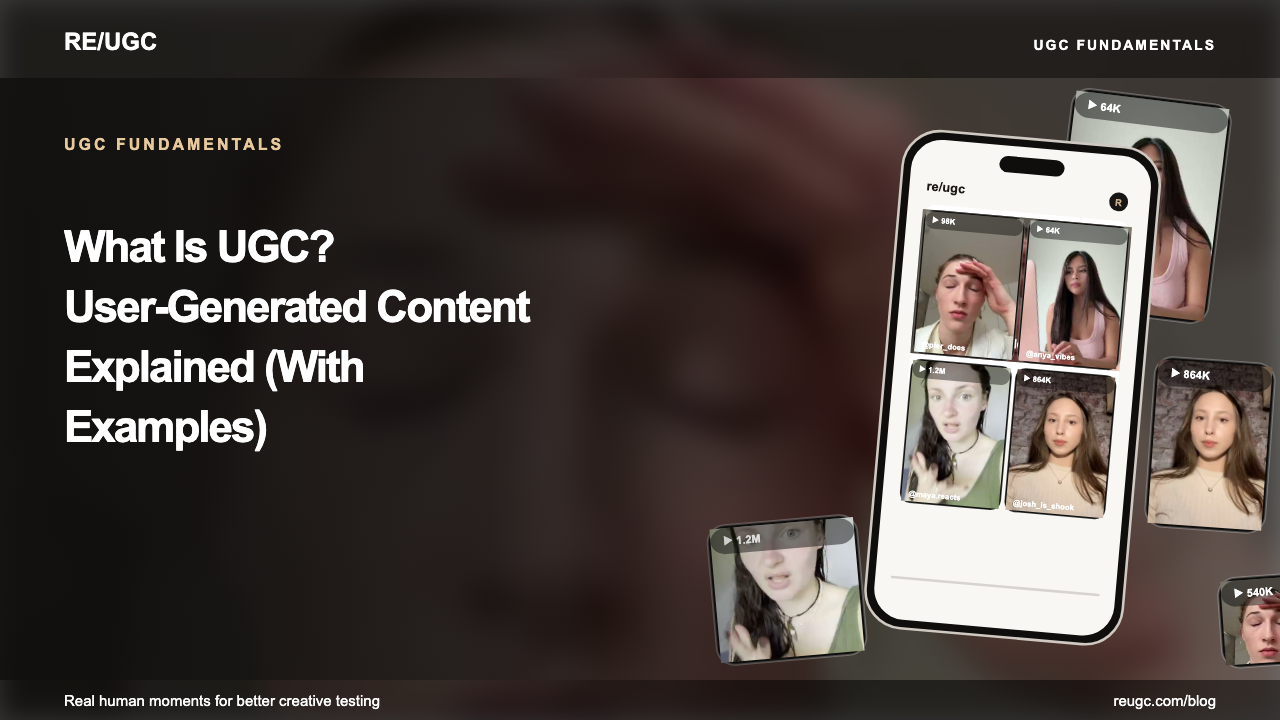
UGC stands for user-generated content — any photo, video, review, unboxing, or social post created by a real person rather than by the brand itself. When a customer films themselves reacting to an app, posts a skincare routine featuring a product, or leaves a detailed review with photos, that's UGC. Brands then reshare it, embed it on product pages, or run it as paid ads.
The reason marketers obsess over UGC is simple: it doesn't look like an ad. People scroll past polished brand creative on instinct, but a real face with a real reaction triggers a pause. That pause — the first one to three seconds of watch time — is where every conversion starts.
UGC meaning: the precise definition
User-generated content is any content — video, image, text, audio, or review — created by individuals rather than the brand, that features or discusses the brand's product. Three things make content 'UGC' in the marketing sense:
- It's made by a person, not the brand's creative team. The creator can be a customer, a fan, an employee, or a paid UGC creator — what matters is that it looks and feels personal, shot on a phone, in a real environment.
- It features the product in a lived-in context. An unboxing on a kitchen counter, an app demo filmed over someone's shoulder, a before/after in a bathroom mirror.
- It carries authenticity signals. Handheld camera, natural lighting, direct-to-camera talking, real reactions. These cues are exactly what platform algorithms and human brains read as 'this is a person, not an ad.'
That last point explains a shift that confuses people new to the term: in 2026, most 'UGC' used in advertising is not spontaneously posted by customers. It's made deliberately — by paid UGC creators, by founders filming themselves, or assembled from licensed clip libraries — in the *style* of organic user content. The label describes the format and feel, not necessarily who paid for it.
What does UGC stand for on TikTok and social media?
On TikTok, Instagram, and YouTube Shorts, UGC almost always refers to short-form vertical video: reaction clips, day-in-the-life product mentions, 'I tested this app' videos, unboxings, and testimonial-style talking heads. When someone's TikTok bio says 'UGC creator,' it means they make this style of video for brands — usually for the brand's own ad account rather than for the creator's audience.
That's the key difference from influencer marketing. An influencer is paid for distribution — access to their audience. A UGC creator is paid for content — the video itself, which the brand runs from its own channels and ad accounts. UGC creators don't need followers at all; they need the ability to look natural on camera. We break down the cost and performance differences in our UGC ads playbook.
The main types of UGC (with examples)
1. Reaction hooks
A 3–5 second clip of a real person reacting — shocked, skeptical, delighted — placed at the front of a video before a hard cut to a product demo. This is the format that dominates app marketing on TikTok because the human reaction earns the watch time and the demo earns the click. See our complete guide to video hooks for why the first seconds carry the entire ad.
2. Testimonials and reviews
Direct-to-camera 'here's what happened when I used this' videos, star-rating reviews with photos, or screen-recorded results. Highest trust density of any format — and the raw material for most retargeting ads.
3. Unboxings and hauls
The anticipation format. Works because the viewer experiences the product reveal at the same moment the creator does. Dominant in ecommerce, beauty, and subscription boxes.
4. Demos and tutorials
'How I use X to do Y' — screen recordings for apps, process videos for physical products. These convert best mid-funnel, after a hook format has earned attention.
5. POV and day-in-the-life
The product appears inside a story rather than as the subject — 'POV: you finally found a budgeting app that doesn't judge you.' Native to TikTok grammar and the hardest for brands to fake convincingly.
6. Organic customer posts
The original meaning of UGC: content customers post on their own, unprompted. Brands collect it via hashtags, mentions, and review requests — then license the best of it for ads and product pages.
Why UGC works: the numbers
| Signal | What the data consistently shows |
|---|---|
| Trust | Consumers rate content from 'people like me' as more credible than brand advertising in every major trust survey since 2019. |
| Ad performance | UGC-style creative routinely beats studio creative on CTR and cost-per-acquisition in paid social — which is why ad accounts now default to it. |
| Watch time | A human face in the first frame lifts 3-second hold rates; reaction-led opens outperform logo-led opens by a wide margin. |
| Purchase behavior | Most shoppers report checking real customer photos, videos, or reviews before buying — UGC on product pages lifts conversion. |
| Cost | A UGC clip costs a fraction of a studio shoot, and testing 10 cheap variations beats perfecting one expensive ad. |
The mechanism behind all of these numbers is the same: UGC borrows the trust of a peer recommendation and applies it at advertising scale. Your brain processes a stranger's genuine reaction very differently from a brand's claim — it reads as evidence rather than persuasion.
People don't skip ads because they hate products. They skip ads because ads look like ads.
What is a UGC creator?
A UGC creator is someone paid to produce user-generated-style content for brands — without necessarily posting it to their own audience. The brand briefs them, they film in their home with their phone, and they deliver raw or edited clips the brand uses in ads, on landing pages, and across social. Rates typically run $100–$300 per video for newer creators and considerably more for proven performers.
For brands, the creator route has real strengths — custom scripts, product-in-hand footage — and real friction: sourcing, briefing, waiting a week or two per batch, and paying per clip whether or not it performs. That friction is why founders increasingly mix approaches: custom creator content for mid-funnel proof, plus licensed reaction-clip libraries for the high-volume hook testing at the top. We compare all the sourcing options — creators, agencies, marketplaces, AI, and stock libraries — in the UGC ads playbook.
UGC vs. influencer marketing vs. brand content
| UGC | Influencer marketing | Brand-produced content | |
|---|---|---|---|
| What you pay for | The content itself | Access to an audience | Production quality |
| Where it runs | Your ad account, site, socials | The influencer's channels | Everywhere |
| Cost structure | Per clip ($0–$300 typical) | Per post (follower-based, $500–$50k+) | Per shoot ($5k–$100k+) |
| Trust signal | 'A real person likes this' | 'Someone I follow endorses this' | 'The brand says so' |
| Best for | Paid social creative, hooks, testing | Reach, credibility transfer, launches | Brand campaigns, TV, web |
| Failure mode | Looks fake if over-produced | Audience mismatch, one-off spike | Skipped in 0.4 seconds |
How brands actually use UGC in 2026
- Paid social ads. The dominant use. A UGC hook (often a reaction clip) opens the ad, a product demo follows, and the whole thing runs as a Spark Ad or dark post from the brand's account.
- Creative testing at volume. Because UGC clips are cheap, teams test 5–20 hook variations per week and let the ad platform find the winner. The hook is the highest-leverage variable — swapping it can double click-through while everything else stays constant.
- Product and landing pages. Customer photos, review videos, and reaction clips embedded near the buy button lift conversion by answering the 'is this actually good?' question with faces instead of claims.
- Organic social presence. Reposting customer content keeps feeds alive without a content team, and signals that real people use the product.
- Email and retention. Review-of-the-week features, community roundups, testimonial snippets in onboarding sequences.
How to get UGC for your brand: 6 routes
1. Ask customers directly
The highest-trust, lowest-cost route. Post-purchase emails ('reply with a video of your first impression for 20% off your next order'), in-app prompts after a success moment, and review requests with photo/video upload. Response rates are low single digits — which is fine, because one great clip can run for months.
2. Run a hashtag or contest campaign
Give customers a reason and a format: a challenge, a template, a prize. This scales collection but demands active moderation and clear terms — state in the campaign rules that entries may be used in marketing, and still get individual permission before paid usage.
3. Hire UGC creators
Brief-driven, custom, product-in-hand. Budget $100–$300+ per video and one to two weeks per batch. Best for testimonials and demos that need your product physically on camera.
4. License from a clip library
Instant access to pre-shot, rights-cleared reaction footage — strongest for the reaction hooks at the front of ads, where the clip doesn't need to feature your product at all (the demo that follows does that job). This is the fastest path from zero to testing.
5. Turn employees and founders into creators
Founder-filmed content carries a specific credibility ('the person who built this is showing me') that no hired creator can replicate. The bar is honesty, not polish.
6. Mine your reviews
Your best ad copy is already written in your five-star reviews — and your best testimonial scripts are hiding in the four-star ones, where praise comes with believable friction. Ask those reviewers specifically for video versions.
Where UGC is heading: AI, libraries, and the authenticity arms race
Two forces are reshaping UGC right now. First, AI-generated 'UGC' — synthetic avatars delivering scripted testimonials — has flooded ad platforms because it's nearly free. Early results show a durability problem: viewers are getting faster at clocking synthetic faces, and platforms are adding AI-content labels that change how the creative is received. Second, licensed clip libraries have emerged as the middle path: reaction footage, pre-cleared commercial rights, instant access, no per-clip creator fees — which is exactly the model RE/UGC runs for reaction hooks.
The pattern to bet on: as feeds fill with synthetic content, verifiably real human moments become more valuable, not less. The formats will keep evolving, but the underlying asset — a genuine face having a genuine reaction — is the one thing that can't be commoditized by a text prompt.
Frequently asked questions
What does UGC stand for?
UGC stands for user-generated content — photos, videos, reviews, and posts created by real people rather than by a brand's creative team.
What does UGC mean on TikTok?
On TikTok, UGC refers to short vertical videos in an authentic, phone-shot style: reactions, testimonials, unboxings, and product demos. A 'UGC creator' on TikTok makes this content for brands to use in their own ads, usually without posting it to their own following.
Is UGC the same as influencer marketing?
No. Influencers are paid to distribute content to their audience; UGC creators are paid to produce content the brand distributes itself. UGC is about the content format, influencer marketing is about the audience.
Do UGC creators need followers?
No. Because brands run the content from their own accounts and ad platforms, a UGC creator's follower count is irrelevant. What matters is on-camera authenticity and the ability to follow a brief.
Can brands use UGC in paid ads?
Yes, with rights in place. Organic customer posts require explicit permission or licensing before use in ads. Paid creator content and licensed clip libraries typically include full commercial usage rights up front.
Why does UGC perform better than regular ads?
It bypasses ad blindness. Authenticity cues — real faces, handheld footage, natural settings — make viewers pause instead of scrolling, and peer-style recommendations are trusted far more than brand claims. More watch time and more trust compound into lower acquisition costs.