



Faceless UGC: How to Make Content Without Showing Your Face
Nine faceless UGC formats that still convert - hands-only, screen recordings, voiceover, POV - plus the honest tradeoff and how to compensate for it.
Plenty of people won't go on camera — privacy, a day job, discomfort, or simply not wanting their face attached to a product forever. Faceless UGC is entirely viable. But it's worth being honest about the tradeoff before choosing it, because the workarounds are only worth learning if you know what you're working around.
The honest tradeoff
Human faces are the strongest attention trigger available in a feed. Face processing is pre-conscious and involuntary — you read an expression before deciding whether to — and that half-second of forced processing is exactly the window a hook competes for. Removing faces means giving up your most reliable pattern interrupt.
So faceless content generally has to work harder in the first two seconds. The good news is that 'harder' has known solutions: motion, anomaly, text, and specificity can all substitute, and one workaround (borrowing a face that isn't yours) removes the tradeoff entirely. More on the mechanism in video hooks.
Nine faceless formats that work
1. Hands-only
Hands using the product, filmed from above or over the shoulder. Still human, still warm, no identity. The closest substitute for a face and the default choice for physical products.
2. Screen recording with voiceover
The native format for software. Works well *after* the hook, but a screen at frame one is the weakest possible opener — so this format needs a strong text or motion hook in front of it.
3. POV / first person
Camera as your eyes: walking into a room, opening a laptop, picking something up. Immersive, native to short-form grammar, and faceless by construction.
4. Text-led with b-roll
A strong written hook over moving footage. The text carries the entire message, which makes this the format that most rewards good writing — and it works muted, which matters especially on Instagram Reels.
5. Voiceover over demo
Your voice carries the personality while visuals carry the proof. A real voice restores a large part of the human signal you gave up — accent, hesitation, and laughter all read as a person.
6. Green-screen over screenshots
Talk over charts, reviews, or competitor pages without appearing yourself — a cursor, a highlight, and a voice. Positions you as an analyst rather than a promoter.
7. Whiteboard / notes-app explainers
Writing appearing in real time as you narrate. The motion of text being written is itself a pattern interrupt, and it holds attention well for explanation-heavy content.
8. Object-only reveals
The product alone, shot with real motion and real lighting. Works when the object itself is visually surprising; fails when it's a rectangle.
9. Borrowed reaction hooks
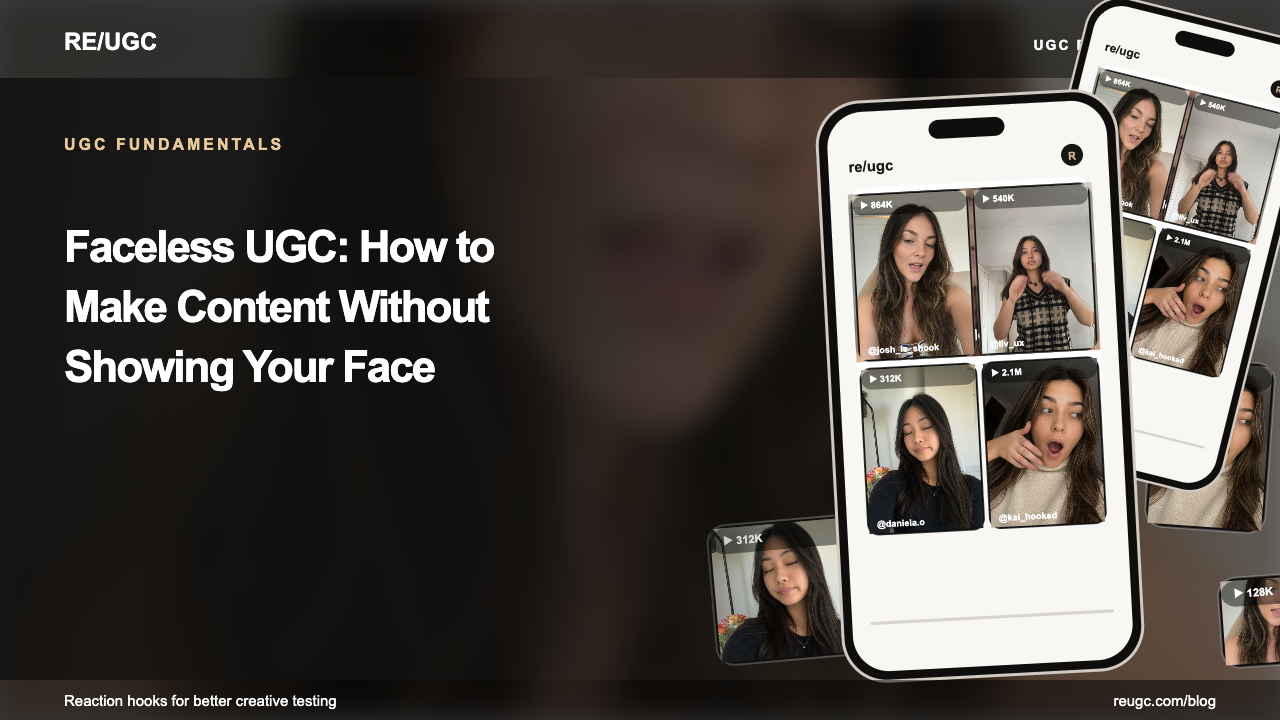
The workaround that removes the tradeoff entirely. Open with a licensed clip of someone else reacting, hard cut to your faceless demo. You get the involuntary attention grab from a human face without ever appearing yourself. For creators who want the performance of face-led content without the exposure, this is the answer — see reaction hooks.
Compensating for the missing face
| What a face gives you | Faceless substitute |
|---|---|
| Involuntary attention in frame one | Motion, visual anomaly, or a borrowed reaction clip |
| Emotional read | Voice — tone, laughter, hesitation carry more than people expect |
| Trust and accountability | Specificity: real numbers, real dates, real screenshots |
| Personality and recall | Consistent visual identity — same setup, same font, same voice |
| Relatability | Named audience: 'if you're a freelance designer…' |
Hook rules for faceless content
- Something must move in frame one. A still opening frame is a scroll invitation, and without a face you have no static substitute.
- Lead with a number or an anomaly. The two fastest-processed stimuli after faces.
- Put the claim in text, top third. Text is doing more work here than in face-led content, and it must survive muted viewing.
- Start mid-action. No setup, no context — the missing beginning is your open loop.
- Be more specific than you think necessary. Without a face to create connection, specificity is your credibility mechanism.
Choosing a format for your product
| Product type | Best faceless format | Why |
|---|---|---|
| Mobile app / SaaS | Borrowed reaction hook → screen recording + voiceover | Screens can't open; a face can, and it needn't be yours |
| Physical product | Hands-only, overhead or POV | Hands supply human warmth and show scale and texture |
| Digital course / info product | Whiteboard or notes-app explainer | The writing appearing is itself the visual interest |
| Agency / service business | Green-screen over client results | Positions you as analyst; results are the proof |
| Ecommerce store | Object reveals with real motion and lighting | The product is genuinely the interesting thing |
| Newsletter / media | Text-led with b-roll | Your writing is the product — demonstrate it |
Building a faceless content system
- Fix your visual identity early. Same font, same colour treatment, same framing every time. Without a face, consistency is what makes your content recognizable in a feed — it's doing the job a face would otherwise do for free.
- Record voiceover in batches. Ten scripts in one sitting keeps energy and audio quality consistent, and it's the difference between publishing weekly and publishing once.
- Build a b-roll bank. Twenty generic clips of your workspace, your hands, your screen — reusable behind any script. This removes the most common faceless-content bottleneck, which is 'what do I put on screen.'
- Keep a hook bank separate from your content. Because your openers do more work here, treat them as a distinct asset you collect and test rather than something you write fresh each time.
- Test one face-led variant anyway. Even if you never publish it, running one borrowed-reaction hook against your usual opener tells you exactly how much the missing face is costing you — and whether the workaround is worth adopting permanently.
Is faceless UGC worth it?
If the alternative is not making content at all, unquestionably. Plenty of successful accounts and profitable ad campaigns have never shown a face. The formats work — they just require sharper writing and stronger openers than face-led content, which is a skill worth having regardless.
And if the only thing keeping you off camera is that you don't want *your* face in the ad, remember that borrowing one is a legitimate option. The reaction at the front doesn't have to be yours; it just has to be real.
Frequently asked questions
Can you do UGC without showing your face?
Yes. Hands-only footage, screen recordings with voiceover, POV shots, text-led b-roll, and green-screen commentary all work. The main adjustment is that your hook has to work harder, since you're giving up the strongest attention trigger available.
Does faceless content perform worse?
At the hook, generally yes — human faces trigger involuntary attention that nothing else fully replaces. Once past the first two seconds, faceless content performs comparably. Many creators solve this by opening with a licensed reaction clip and staying faceless for the rest.
What's the best faceless format for apps?
A strong hook — text, motion, or a borrowed reaction clip — cut into a screen recording with voiceover. Screen recordings are the natural demo format for software but the weakest possible opener, so the first three seconds need to come from somewhere else.
Can I use someone else's face in my faceless content?
With proper licensing, yes. Licensed reaction clips give you a real human face at the hook with commercial rights included, while everything after stays faceless. Never use footage of someone without a license covering paid advertising.
How do I build trust without showing my face?
Specificity replaces familiarity. Real numbers, real dates, real screenshots, and a consistent voice across content build credibility over time — and a real voiceover carries more human signal than most people expect.