







UGC Agency Alternatives for Lean Marketing Teams
Compare customers, freelancers, creator marketplaces, libraries, and in-house production as alternatives to a full UGC agency.
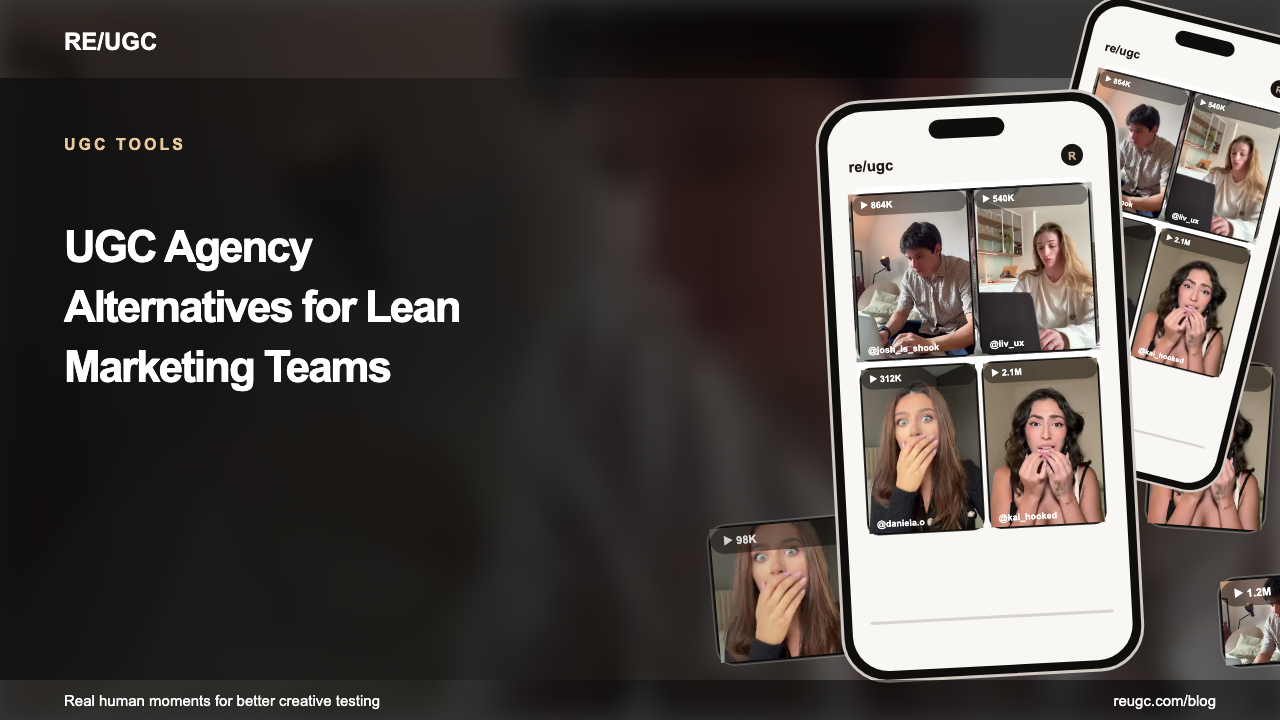
A UGC agency can provide strategy, creators, production, and account management — but it is one route, not the only route, and for lean teams it's frequently the wrong one. The agency model trades money for attention: it's built for teams whose constraint is time, not budget. If you have a clear product demo and a burning need for frequent hook tests, the faster learning often comes from a modular library, a small creator roster, or an internal editor — because the thing you actually need is volume, and volume is what per-creative pricing punishes.
This guide compares every practical alternative to a full-service agency — customers, freelancers, marketplaces, licensed libraries, and in-house production — with the honest tradeoffs, the cost-per-experiment math, and the rights discipline each one demands. It's the decision layer on top of our UGC platforms buyer's guide and the agency vs. stock library breakdown.
Why teams outgrow the agency model
Agencies win on coordination and craft. But three structural realities push lean teams off the retainer:
- Cost per experiment is brutal. A $4,000/month retainer producing twelve videos is $333 per creative — and creative testing wants dozens of cheap shots, not a dozen expensive ones. The cost analysis in our UGC pricing guide shows the gap clearly.
- Iteration runs on their clock. Agency production cycles are measured in weeks while ad platforms learn in days. When the data says 'test a new hook,' waiting two weeks is the same as not testing.
- Creative fatigue doesn't pause for invoicing. Winners need constant refresh — new faces, new angles — and a per-clip model punishes exactly the behavior that wins paid social.
An agency solves your coordination problem. If coordination isn't your problem, you're paying for a solution you don't have.
Compare the models
| Model | Best for | Tradeoff |
|---|---|---|
| Customers | Credible lived experience | Harder to scale and direct |
| Freelance creators | Specific voices and niches | Briefing and rights management |
| Marketplace | Fast creator discovery | Variable consistency |
| Licensed library | Fast hook volume | Less product-specific proof |
| In-house | Control and repeatability | Needs people and process |
| Agency | End-to-end support | Higher cost and less control |
Model deep dives
Customers
Your own users making testimonial-style clips. The credibility is unmatched — it's real people, real product, real results — but customers aren't a production line: they don't follow briefs tightly, they can't be scheduled, and they may not appear on camera well. Best used as a proof layer for winners, not as a volume source. The tradeoffs versus licensed footage are laid out in stock UGC vs. custom UGC.
Freelance creators
Direct-hired creators you brief, pay, and manage yourself. You get specific voices and niches and — critically — your product physically in frame, which no ready-made reaction library can offer. The cost is operations: briefs, contracts, revision rounds, and rights negotiation are all on you. The creator-sourcing mechanics are covered in the UGC platforms guide.
Creator marketplaces
You post a brief and creators apply or get matched. Fast discovery, but quality variance is the persistent complaint — the same brief produces one usable video and two unusable ones, and you pay for all three. At $150 a clip, five hook variants cost $750 before you learn anything. It's a reasonable middle ground when you need product-in-hand testimonials at moderate volume.
Licensed clip libraries
Pre-recorded reaction footage with rights included, available instantly. The cost-per-experiment problem disappears — the hook, the highest-leverage part of any ad, becomes effectively free to vary, so five hooks against a fixed demo costs nothing extra and takes an afternoon. The constraint: clips can't feature your product in hand, which matters mostly for testimonials, not for the reaction-hook format where the product appears in the demo that follows. This is the model RE/UGC runs.
In-house production
An editor (or founder) cutting ads internally. Maximum control, repeatability, and speed — once the process exists. The real cost is the pipeline: someone has to source footage, brief, manage rights, and keep the variation treadmill moving. The faceless UGC guide covers how lean teams run this without any on-camera talent at all.
The cost-per-experiment lens
Comparing models on cost per video is the wrong metric. The right one is cost per experiment — what it costs to learn one thing about what your audience responds to:
| Route | Cost to test 5 hooks on one demo | Time to result |
|---|---|---|
| Agency retainer (5 of 12 monthly assets) | ~$1,650 of a $4k retainer | 2–4 weeks |
| Marketplace creators ($150/clip) | $750 | 1–2 weeks |
| Freelance creator (single brief, 3 clips) | $300–$750 | 1 week |
| Licensed library (flat fee, already owned) | $0 marginal | 1 afternoon |
This is why high-performing accounts end up blended: libraries for hook volume, customers or creators for product-in-hand testimonials, in-house for speed. The hybrid is covered below; the AI angle — synthetic actors and voiceover for localization — is analyzed in AI UGC if you're tempted to add that layer.
A hybrid model
Many lean teams land on a hybrid: licensed footage for rapid hook tests, a fixed internal demo for product proof, and commissioned creators for concepts that have already earned attention. This avoids spending custom-production time on messages that have not yet proved their relevance — and it's the same logic as testing creatives before scaling them.
- Document your claims and audience before sourcing creators.
- Create a rights checklist for every asset.
- Use a modular template to separate hook from body.
- Reserve custom creator budget for proven mechanisms.
- Review cost per useful learning, not cost per delivered video.
Rights and operations checklist
Whatever models you blend, the rights discipline is non-negotiable — it's the most common way an 'alternative' quietly becomes an expensive mistake:
- Paid ad usage in writing. Many marketplaces include organic but charge extra for paid — confirm before running.
- Duration and platform coverage. State the term (or 'no expiry') and all platforms explicitly.
- Whitelisting / Spark Ads permitted. If you plan to run creator posts as ads, get it in the contract.
- Raw files or edits only. Agencies often deliver edits only; creators often deliver raw. Know which you're paying for.
- Unused concepts stay yours. Confirm what happens to concepts you paid for but never used.
The full guardrails — including FTC disclosure and likeness issues — are in UGC rights and best practices. And if you're assembling the tool stack for any of these routes, the best UGC tools roundup covers the software side.
Frequently asked questions
When is an agency worth it?
When you need strategy, creator operations, rights, and production at a volume your team cannot support, and the economics justify the coordination cost. If your constraint is attention rather than budget, an agency is the honest answer.
Can a library replace testimonials?
It can supply attention and reactions, but product-specific testimonial proof may still require customers or commissioned creators. The library handles the hook; the testimonial handles the claim that needs your product in frame.
What should I keep in-house?
Keep customer insight, claims, measurement, and final approval close to the product even when production is external. The models you outsource change; the understanding of your buyer should never.
What's the cheapest way to start?
A licensed library for hook openers plus your own screen recording costs a one-time fee and ships this week. Add customers or creators only after a hook mechanism has proven it can hold attention.
Is in-house really cheaper than an agency?
Over volume, yes — but only once the pipeline exists. If nobody owns sourcing, briefing, and rights, in-house just becomes an empty process you pay for with time instead of money. Be honest about which resource is actually scarce.