







Stock UGC vs Custom UGC: Which Should You Use?
Understand when stock UGC footage, custom creators, customers, or a hybrid model is the right choice for performance creative.
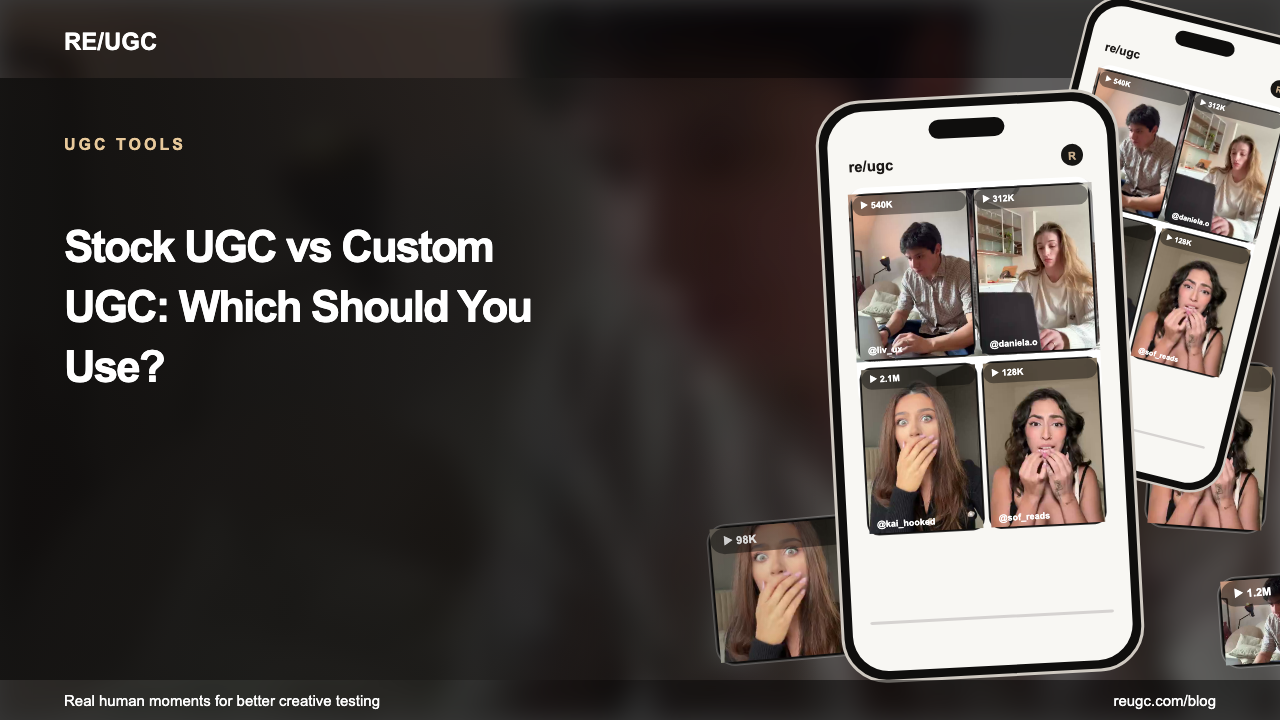
Stock UGC is useful when you need a relevant reaction opening quickly and repeatedly. RE/UGC offers hyperrealistic AI UGC for that opening. Custom UGC is useful when the creator must explain a product-specific experience, demonstrate a physical product, or provide a genuine testimonial.
The right comparison is not stock versus custom in the abstract — it's cost and speed of learning versus depth of product proof. For an app, a library reaction plus screen recording may be enough. For a skincare product, a creator's real routine and time frame may be central to belief. Let the claim decide. If you're still mapping the sourcing landscape, UGC platforms compared is the wider view.
Side-by-side
| Factor | Stock UGC | Custom UGC |
|---|---|---|
| Speed | Immediate | Brief, production, revisions |
| Hook volume | High | Limited by creator capacity |
| Product proof | Needs your demo | Can be captured directly |
| Cost per iteration | Low | Higher |
| Specific testimonial | Limited | Strong when truthful |
| Rights | License terms | Negotiate and document |
When stock UGC wins
Stock UGC wins on the hook — the opening 3–5 seconds where the viewer decides whether this is a person or an ad. Reaction clips, skeptical-turned-sold moments, and everyday lifestyle footage do this job well, and they do it instantly and repeatedly: five hook variations against one demo takes an afternoon rather than two weeks. Because the cost per variation is effectively zero once the license is owned, stock UGC is the natural engine for the volume testing that creative performance demands. The mechanism is explained in the video hooks guide.
- Testing hooks at volume. The cheapest way to learn which opening earns attention.
- Fast cold-launch. Ship a batch this week without waiting on creator availability.
- Reaction-led formats where the product appears in the demo that follows, not in the clip itself.
- Budget discipline. One license instead of per-clip creator fees — the math lives in the UGC ad cost guide.
When custom UGC wins
Custom UGC wins when the proof must be product-specific. A physical product needs hands on it. A testimonial needs a real person's real usage over time. A niche B2B claim needs someone who visibly understands the workflow. In those cases stock footage is the wrong tool no matter how good the clip is — the claim and the evidence have to come from the same place. For the briefing side of commissioning those creators, see how to write a UGC ad script and the UGC scripts template library.
- Product-in-hand demos for physical goods and hardware.
- Honest testimonials with time frames and caveats that stock can't supply.
- Niche-credibility videos where the speaker's identity is the proof.
- Founder stories that explain why the product exists — a format stock footage can never produce.
The hybrid workflow
- Use stock reactions or openers to test five motivations fast and cheaply.
- Build the best message around a clear product demo — your own screen recording or footage.
- Commission custom creators for the mechanisms that win, once you know attention is earned.
- Keep the same measurement and rights discipline across both sources.
- Refresh hooks without replacing proof that remains effective.
Use stock for the test, custom for the proof. The team that tests five motivations this week almost always outlearns the team that waits five weeks for one perfect custom video.
Rights: the difference that matters
Stock and custom differ as much in rights as in production. Stock: confirm the license covers paid advertising, editing, channels, territory, and duration — and that there's no expiry you'll trip over mid-scale. Custom: negotiate usage up front and get channels, duration, paid usage, whitelisting, and raw-file access in writing before production. Both failure modes are covered in our UGC rights checklist, and the cost implications in the UGC ad cost guide.
A decision framework
| Your situation | Start with | Add later |
|---|---|---|
| App or SaaS, no physical product | Stock reaction + your screen recording | Custom testimonials for winning mechanisms |
| Physical product, cold traffic | Stock openers + your product b-roll | Custom unboxing and routine videos |
| High-trust / niche B2B offer | Custom founder or expert video | Stock hooks to find the winning angle first |
| Budget-constrained, need ads now | Stock-first batch this week | One creator for the best-performing claim |
| Scale phase ($20k+/month spend) | Hybrid: stock volume + managed creators | Localization and niche-reframed re-cuts |
The mistakes that make the decision wrong
- Buying custom before you know the claim. If you don't know which message earns attention, five cheap hook tests come first — custom production behind an untested claim is the most common overspend.
- Using stock to fake a testimonial. A talking-head clip that implies first-hand experience without it is a compliance risk and a believability fail. Stock handles reaction; only real usage handles testimonial.
- Letting per-video cost hide the total. A $150 creator clip plus rights plus revisions can reach $300–$400 by the time it ships; a library license amortizes across every variation.
- Never re-cutting. The highest-leverage reuse — swapping hooks against one proven demo — is impossible when footage arrives edits-only. Ask for raw files.
- Skipping the measurement split. If you can't see hold rate, CTR, and conversion separately, you can't tell whether the source or the message was the problem.
The cost math that settles most debates
Compare cost per experiment, not cost per file. Five custom hook variations from a creator at $150 each is $750 and one to two weeks. The same five variations from a licensed clip library is $0 marginal and one afternoon — but stock can't deliver the product-in-hand testimonial custom can. Once you know which claim your audience believes, you spend custom production budget only where stock can't reach. That sequencing is exactly the process in our creative testing framework.
Frequently asked questions
Does stock UGC look fake?
It can if used generically. Choose footage that matches the emotion and audience, edit it naturally, and connect it quickly to real product evidence. Native is a communication choice, not a property of the file.
When do I need custom UGC?
Use custom footage when product handling, personal experience, niche credibility, or an honest testimonial is essential to the claim. If the proof can live in a demo that follows a reaction clip, stock often suffices.
Can I use stock footage in paid ads?
Yes, when the license clearly covers paid advertising, editing, channels, territory, and duration. Confirm those terms before running, not after a platform flags the asset.
Is stock UGC cheaper than custom?
Yes per iteration — one library license versus per-clip creator fees — and it makes hook testing dramatically cheaper. But custom is the only option for product-in-hand proof and genuine testimonials, so 'cheaper' depends entirely on what the asset must prove.
Should I mix stock and custom in one campaign?
Yes — most scaling accounts run stock reactions as the hook and custom footage where the claim needs it, inside the same ad. The hybrid workflow above is the standard pattern.
Does using stock hurt performance?
Not if the claim and proof connect. Audiences clock mismatch — a generic face with no connection to the product — far faster than they clock 'licensed footage.' Pair stock openers with your own demo and it performs like native creative.