





A Practical Guide to UGC Ad Examples
A practical way to study UGC ad examples, identify the mechanism behind each winner, and turn patterns into testable briefs.
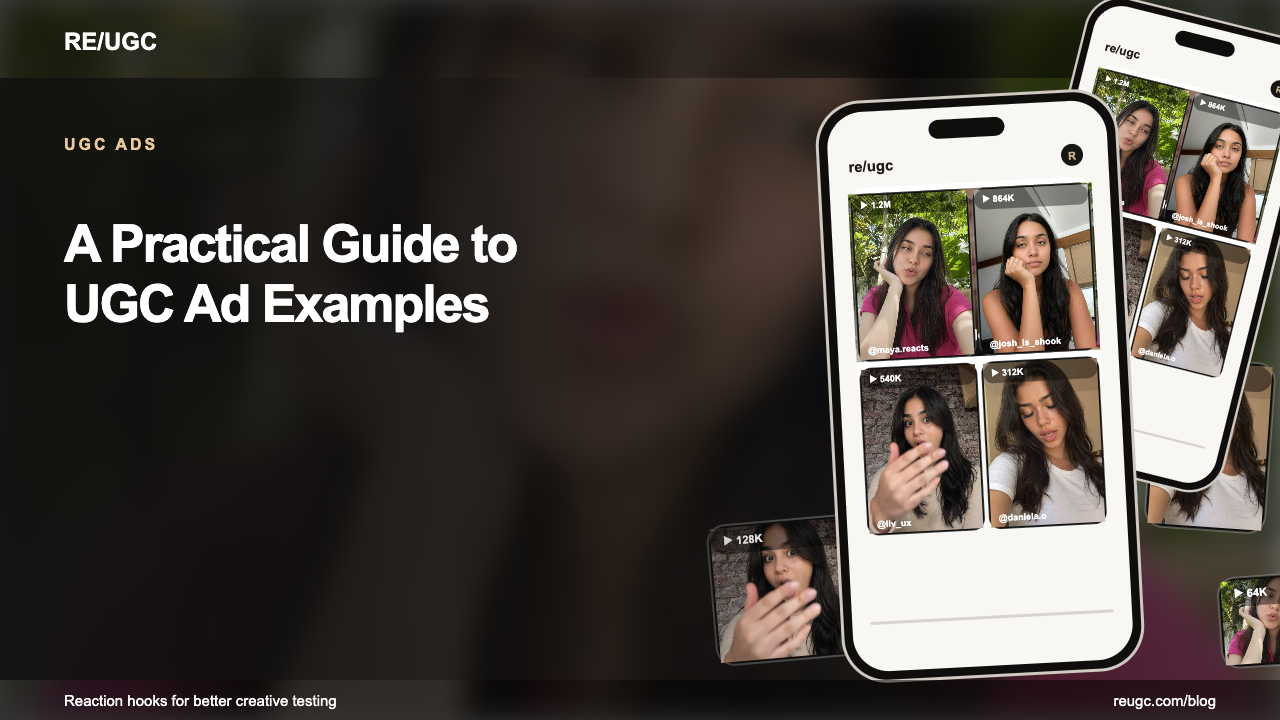
A useful UGC ad example is more than a creator talking to camera. It is a compact lesson in attention, proof, and persuasion. When you study an ad, ask what job each moment performs: does the opening stop the scroll, does the middle demonstrate a believable outcome, and does the close make the next step feel easy? That framework is more reusable than copying someone else's words.
Start with the UGC ads playbook, then use the examples below as a briefing tool for your next batch. If you want more raw material before you start analyzing, our UGC ad examples gallery is a good place to build a swipe file.
Six UGC formats worth studying
| Format | What to inspect | Best use |
|---|---|---|
| Reaction + demo | Emotion in frame one and speed of payoff | Apps and visual products |
| Problem / solution | Specific pain before the product appears | Cold acquisition |
| Testimonial | Caveats, time frame, and proof | Warm audiences |
| Comment reply | Question creates context | Objection handling |
| POV skit | Native story and product role | TikTok discovery |
| Founder explanation | Why the product exists | Trust-heavy offers |
How to break down an example
- Transcribe the first three seconds exactly. Mark the first face, claim, movement, and caption.
- Write the promise in one sentence. If you cannot, the hook is probably vague.
- Note the proof type: screen recording, result, process, comparison, or another person's reaction.
- Find the objection the ad answers. Price, effort, trust, complexity, and switching cost are common ones.
- Describe the CTA as a level of commitment. A free trial and a purchase ask are not interchangeable.
Do this for ten examples and patterns appear fast — you'll notice that winners cluster around two or three hook mechanisms and one or two proof types. That clustering is your signal for what to test next, and it's the exact method behind our reaction hooks guide.
Three teardowns: decoding the mechanism
The app ad that won on the hook
A 2-second shocked-face reaction clip, caption 'wait, it does THAT?', hard cut to a screen recording of the app auto-organizing a chaotic list. The reaction set an expectation the demo instantly cashed. The team tested the identical demo against six reaction clips — hold rate between best and worst hook differed by nearly 2x with every other frame identical. Lesson: the hook was the ad. More on this pattern in the video hooks guide.
The testimonial that scaled on a hedge
A 30-second talking head opening with 'I almost returned this.' Mid-video before/after inserts, and one honest hedge at the end: 'it took three weeks, not three days.' The opening admission bought credibility that a positive open never earns, and the hedge inoculated the comments against 'fake review' pile-ons. Lesson: skepticism, honestly resolved, outsells enthusiasm. The UGC scripts templates show how to brief a creator to deliver this.
The skit that beat the studio campaign
An 18-second problem–agitate–solve: a founder acting out checking three banking apps at 11pm, caption 'every. single. month.', pivot to a 6-second demo of the consolidated dashboard. Shot on a phone in one evening. It out-delivered a $40k studio campaign on CPA because it entered the feed as content, not as an interruption. Lesson: production value is not a ranking factor — pattern-matching to 'person' is.
Patterns that transfer across industries
The strongest examples usually combine a human signal with a concrete artifact. A creator says, 'I thought this would take hours,' while the screen shows the workflow completing in seconds. The face supplies identification; the artifact supplies evidence. Another durable pattern is qualified praise: 'I still use it, but the setup took me one afternoon.' A limitation makes the positive claim credible.
- Open with a customer tension, not a brand introduction.
- Show the product doing the promised job before explaining every feature.
- Use the customer's vocabulary from reviews, support tickets, and sales calls.
- Keep one primary claim per version so results can teach you something.
- Make the footage feel native to the feed, while keeping claims and rights accurate.
The best UGC ad examples aren't scripts to copy — they're mechanisms to test. Your audience will tell you which mechanism they believe, if you give them the chance to vote.
Turn examples into a test brief
For each pattern, write five hooks and hold the demo constant. A brief should name the audience, problem, proof moment, desired emotion, CTA, aspect ratio, and claim that needs approval. This turns inspiration into a controlled experiment. Test the mechanism first, then refine wording after you know whether the mechanism earns attention. The full experimental structure lives in the creative testing guide.
Where to find good examples
- The TikTok Creative Center and Meta Ad Library — filter by industry and engagement, sort by performance.
- Your competitors' top comments. The objection being asked most often is your next ad's script.
- Review sites and Reddit. Customer language is the raw material; the UGC marketing post explains how to turn it into hooks.
- Your own account's past winners. The ad that worked in Q1 is usually a mechanism worth re-testing against a new demo.
- Benchmark roundups like our UGC benchmarks data, so you know what 'good' even looks like per format.
Frequently asked questions
Can I copy a successful UGC ad?
Copy the structure and psychological mechanism, not the creator's script, identity, footage, or claims. Rebuild the idea around your audience and product — and verify any performance claims before repeating them.
What makes an example worth saving?
Save examples with a clear hook, visible proof, and a format you can produce repeatedly. A one-off celebrity moment is less useful than a repeatable pattern.
How many examples should a creative team study?
Study 10 to 20 examples, tag their mechanisms, and choose two or three patterns for the next test batch. More references are not automatically better.
What's the most common mistake when studying UGC examples?
Copying the words instead of the mechanism. Transcription gives you surface; teardown gives you the psychology. Always write the promise in one sentence before you reuse anything.
How do I know an example will work for my product?
You don't until you test it against your own demo. The framework in [how to test ad creatives](/blog/how-to-test-ad-creatives) exists precisely because creative performance is not portable — mechanisms partially are.
Should I study examples from my industry only?
Mostly yes, but the highest-leverage examples often come from adjacent industries. An app that hooks with a reaction teaches a DTC brand something the DTC category never shows.